How a 56-Year-Old Broke Through Years of Plateaus in 16 Weeks
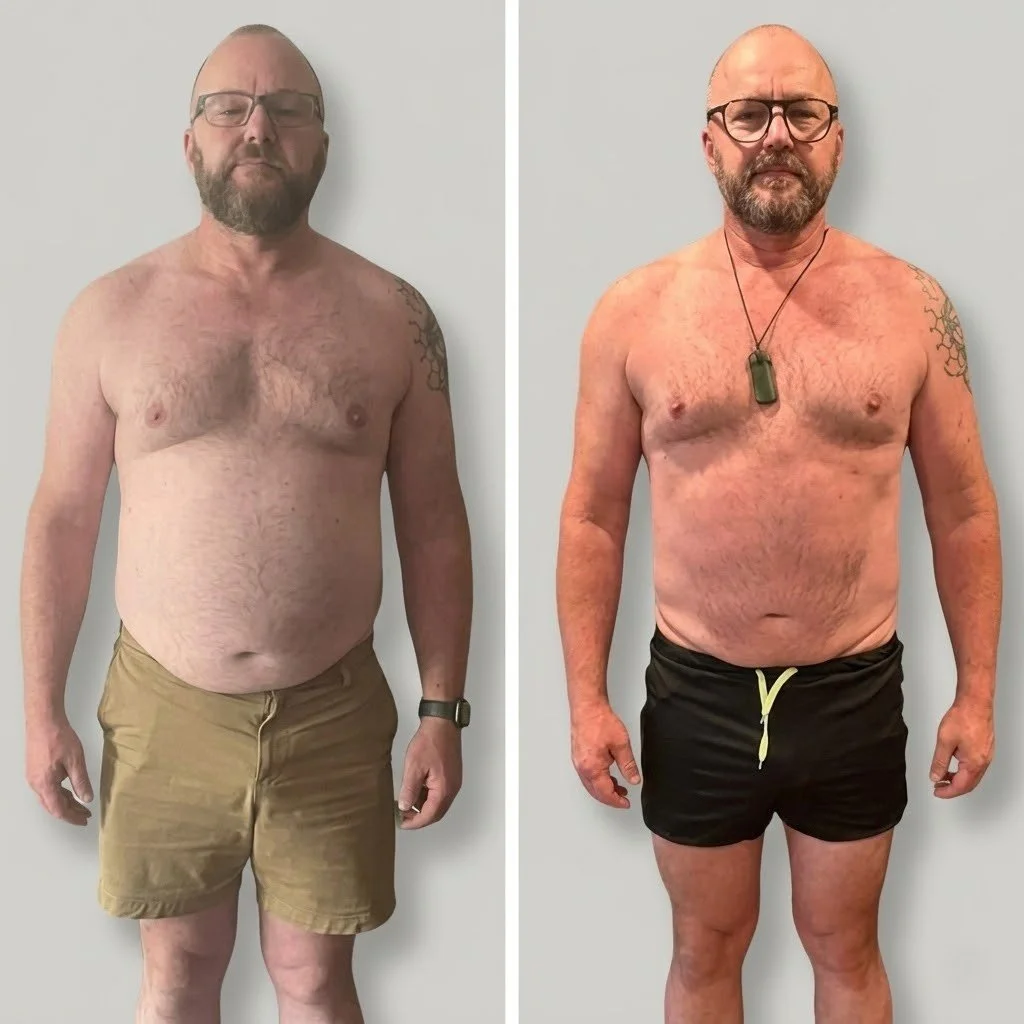
16 WEEKS | +12LBS MUSCLE | -12% BODY FAT
Andrew sent me his first set of progress photos, and I could see the problem immediately. He was 56, had been training on and off for years with multiple trainers, worked hard, showed up consistently, and followed the programs they gave him. And for all that effort, he'd gotten nowhere. Completely plateaued. Frustrated. At that point, he was starting to wonder if his body had just stopped responding.
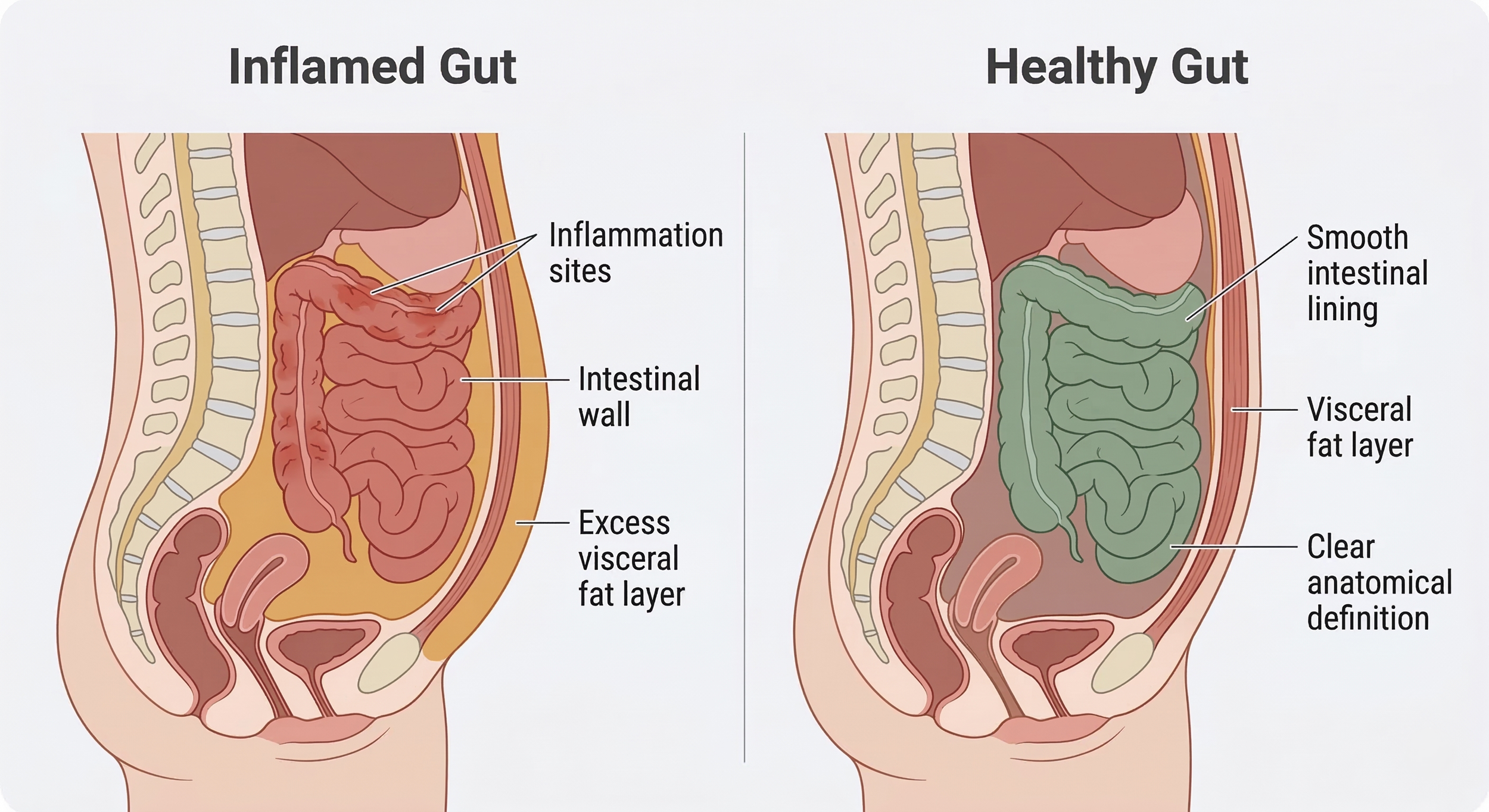
The issue wasn't effort. It never is with guys like Andrew. When I looked at those photos, I saw a gut that was massively inflamed. Not just carrying extra fat around the midsection. It was inflamed and bloated. His body was holding onto something it couldn't process, and no training program was going to fix that until we addressed it.
We started working together exclusively remotely. Andrew is on the West Coast, I'm in Montreal. No in-person training. Just a structured program through the app, weekly check-ins, and Andrew showing up every day to do the work on his own.
16 weeks later: 12 pounds of lean muscle, 12% body fat lost, and a completed Inca Trail in Peru. Something he knew for a fact, the pre-program version of himself wouldn't have survived without injury. Here's what actually changed.
Where Andrew Started: The Plateau Years
When someone tells me they've been training consistently but seeing no progress, I don't start by reviewing their workout plan or macros. I look for the systems underneath. The factors that determine whether their body can respond to training in the first place.
Andrew had a few things working against him. His gut was inflamed, which was blocking fat loss regardless of how clean he ate. His recovery capacity at 56 wasn't what it was at 35, but he was training like it was. And his pescatarian diet left him short on specific nutrients. B vitamins, iron, zinc. Those are easy to get from red meat but hard to replace through fish and vegetables alone.
On top of all that, Andrew was on a sobriety journey. Training became part of what kept him on track: the structure, the accountability, the focus on building something real every day. I'm not going to pretend the training fixed his sobriety work. That was his fight, and he did it. But having something to show up for every day. Something with visible, measurable progress that matters when you're fighting a bigger battle.
Every session logged, every check-in completed, every small win reinforced the one happening somewhere else in his life. The physical transformation is usually the byproduct of building systems that work everywhere. Andrew was stacking wins across the board. That momentum carried.
Weeks 1–5: Building the Foundation
The first 5 weeks weren't about transformation. They were about establishing a pattern Andrew could sustain and collecting the data I needed to know where his body actually was.
Training structure: 4 days per week, upper/lower split. Here's exactly what that looked like, along with the actual program he followed.
A few things worth noting about how the program was structured.
Every session is built in three tiers:
| A Series | B Series | C Series |
|---|---|---|
| Primary lifts | Accessory | Remedial |
The remedial work isn't optional; it's what keeps joints healthy enough to handle the training volume. Horse stance, tibialis raises, passive hangs, grip work. It looks basic. It matters a lot.
Each lower-body session pairs a squat pattern with a hip-hinge or unilateral work. Upper days pair a push with a pull. The goal in Phase 1 was to build fundamental patterns and load tolerance that would support heavier work later. Not to crush him in week one.
Progressive overload target: add 2 to 5 pounds per week on main lifts, with proper technique. If his form broke down, we held the weight and added reps instead. Build strength without compensation patterns sneaking in.
What we tracked every single week:
1) Resting heart rate
2) Blood pressure
3) Training readiness
4) Body weight
5) Sleep quality
Nutrition: We aimed for balanced meals every 2 to 3 hours. Salmon, a protein shake, simple rotation for carbohydrates, gluten-free pasta, roasted fish, broccoli, sweet potato, and asparagus. Food he could prep in bulk and cycle through the week.
Macronutrient Goals: 180 to 200 grams of protein per day (roughly 1 gram per pound of target body weight), 120 to 150 grams of carbs on training days, healthy fats from fish oil, olive oil, and whole food sources.
Conditioning: 3 sessions per week, 30 to 45 minutes, heart rate between 120 and 140 BPM. Incline treadmill walking, stationary bike, or rowing machine. Whatever, his joints felt good that day. No HIIT. At 56 with existing inflammation, high-intensity intervals would have just spiked his cortisol and made everything worse. We needed to build his aerobic base first. The foundation that lets his body recover between strength sessions and supports fat oxidation properly.
Range & Flexibility: 10 to 15 minutes, 4-5 days per week after his main training sessions and one extra on his off days.
| Weeks 1–3 | Basic Flexibility work: Couch stretch, Pike stretches, and Shoulder Flexion & Extension stretches. That started to unlock ranges of motion that had been locked for years. |
|---|---|
| Weeks 4–5 | Loaded Stretching: Jefferson curls, Loaded 90/90 hip stretches for hip internal and external rotation, Deep Loaded Squat Holds. |
The long-term flexibility goals were front split and side split, not because splits are impressive (which they are, hahaha), but because the strength and control required to get there translate directly into how well you move in everyday life. Better hip mobility, better knee stability, better spinal position under load. Move however you want, whenever you want, without having to think about it.
By the end of week 5, strength was up. Conditioning was building. Heart rate recovery between cardio intervals improved noticeably by week 4.
But his body composition wasn't moving fast enough. His weight dropped 3 pounds, but his midsection didn’t show much improvement. The gut inflammation was still sitting on top of everything. That's when I decided to make a change.
Week 5: The Adjustment That Unlocked Everything
I told Andrew to cut gluten completely. Don’t reduce it. Eliminate it.
Within 2 weeks, the inflammation started coming down. Within a month, his midsection looked completely different. Not because he'd lost 20 pounds, but because his body had stopped holding onto the bloat and inflammation that had been sitting on top of everything.
Why does gut inflammation block fat loss? Here's the simple version: chronic inflammation elevates cortisol and makes everything harder. Elevated cortisol tells your body to hold onto fat, particularly around the midsection. It also impairs insulin sensitivity, which means your body handles carbohydrates worse and stores more of them as fat. You can be eating clean and training hard, and if your gut is inflamed, your body will fight you the whole way.
Once the inflammation subsided, Andrew's body could actually respond to training as it was supposed to. Before week 5, it didn't matter how hard he worked; his system was too inflamed to process anything correctly. One change. That's what unlocked the next 10 weeks.
Weeks 6–10: When the Body Finally Started Responding
Once Andrew's gut inflammation subsided, everything accelerated, and this is where I see the same pattern in almost every client who's been plateaued for a long time.
Week 6: Body weight dropped another 4 pounds. His midsection visibly flattened. Waist measurement dropped 1.5 inches in one week. That wasn't fat loss; that was inflammation finally releasing.
Week 7: Strength jumped. His body was finally adapting to the training stimulus instead of just fighting inflammation.
Weeks 8 to 9: Hit a wall, that's completely normal at this stage. Work got chaotic, and sleep dropped to 5 to 6 hours instead of his usual 7 to 8.
This is the point where most people either push through and dig a deeper hole or quit entirely, because they think the program has stopped working. Neither is right. I pulled back the volume. He did two strength-focused training sessions and optional Flexibility & Range sessions that week instead of the regular 4 strength sessions, just the main lifts at lower volume, no cardio, mobility work, and walks only. His body needed to recover, not get buried under more load.
Week 9 check-in: Sleep and recovery normalized. We ramped back up. Week 10: Body composition was visibly changing. Clothes fit better. Definition showing in his shoulders and arms.
This is the phase most people never reach because they quit when the scale slows down. Building muscle while losing fat means the number on the scale doesn't move dramatically; the mirror and the clothes tell you everything. Andrew stayed in it.
The Training That Actually Built Muscle at 56
Most people think progressive overload means one thing: add weight to the bar. That's part of it. But with Andrew, we used an undulating periodization model, meaning both intensity and volume ramped up together over the 16 weeks, not just one or the other.
Why does that matter? Because your body adapts fast. If you only increase weight, you hit a ceiling. If you only increase volume, you burn out. When you wave both more load some weeks, more sets and reps others, you keep the adaptation signal strong without destroying your recovery capacity. At 56, that balance is everything.
Here's what that looked like in practice. Early phases were built around technique, establishing baseline strength, conservative loads, controlled reps, and movement patterns that would hold up under heavier work later. As his body began to respond, we shifted. Main lifts moved to lower rep ranges with higher intensity. Accessory work stayed in higher-rep ranges, but volume gradually increased during the accumulation phases, and intensity and sets increased during the intensification phases, while total volume decreased. This creates a perfect wave, alternating between volume and intensity.
We also added tempo prescriptions on key exercises as the weeks progressed. Slowing the eccentric phase, the lowering portion increases mechanical tension on the muscle and builds tendon strength and resilience without requiring a heavier load. For someone dealing with years of accumulated joint stress, that's a big deal. You get more out of a weight that your joints can actually handle.
By week 16, Andrew was meaningfully stronger across every major pattern: squat, hinge, press, pull. Not just a little stronger. The kind of strength gains that show up in how you move, how you carry yourself, and how you feel walking up a flight of stairs. That's what 16 weeks of progressive, well-managed loading does when the foundation is right.
The Flexibility System (And Why It Actually Mattered)
Most people treat flexibility as an afterthought, 5 minutes of stretching quickly at the end of a session. For Andrew, it was a core reason the training worked.
| Weeks 1–3 | Basic Flexibility work: Couch stretch, Pike stretches, and Shoulder Flexion & Extension stretches. That started to unlock ranges of motion that had been locked for years. |
|---|---|
| Weeks 4–5 | Loaded Stretching: Jefferson curls, Loaded 90/90 hip stretches for hip internal and external rotation, Deep Loaded Squat Holds. |
By week 16, Andrew could squat below parallel with no lower back rounding, his hips moved freely in all planes, and he had zero joint pain during training. The front split and side split weren't there yet, but the foundation was.
That flexibility work is why he crushed the Inca Trail. Hiking at altitude on uneven terrain for hours requires hip mobility, ankle stability, and the ability to load your joints through a full range of motion without compensation. Andrew had all of that when he left for Peru.
How Remote Coaching Actually Worked
Many people ask whether remote training can actually produce real results. Andrew's transformation happened entirely through our app and weekly check-ins. Here's exactly how.
Daily: Andrew logged every training session, sets, reps, weight, and how he felt. I reviewed it that night and left feedback. And adjustments were made right away when needed.
Check-Ins: Every Monday, Andrew submitted his weekly check-in form. Body weight, resting heart rate, blood pressure, training readiness score, sleep average, any questions or issues. I reviewed it, recorded a 3- to 5-minute video or voice note response, and either confirmed next week's plan or adjusted it based on recovery markers.
The key was Andrew's consistency. He logged everything. He checked in every week without fail. If he missed a session or something felt off, he told me. Remote training works when the client is disciplined enough to follow the plan and honest enough to report what's actually happening. Andrew was both.
What Didn't Work (Before We Found What Did)
I would rather you not think this was a clean, linear process because it wasn't.
Over 16 weeks, we made adjustments. Some things we tried didn't land the way I expected. The volume that looked right on paper pushed his recovery too hard. The intensity thresholds we tested didn't suit where his body was at that point. Nutrition approaches that work well for other clients didn't fit his schedule or his digestion. Each time something didn't work, we pulled back, reassessed, and adjusted.
That's not failure. That's how coaching actually works. A program on paper is just a starting point what it becomes over 16 weeks is shaped entirely by how the client responds. Andrew's resting heart rate, his training readiness scores, his sleep, his energy in sessions, all of that was telling us something every single week. When the data said back off, we backed off. When it said push, we pushed.
Most people never get this kind of feedback loop because they're either training alone with no tracking or following a generic program that has no mechanism for adjustment. Andrew had neither of those problems. Every variable was monitored. Every adjustment was deliberate. That's what remote coaching with real check-ins actually gives you.
Weeks 11–16: Preparing for the Inca Trail
Around week 11, Andrew told me he'd booked the Inca Trail for week 17. That gave us 5 weeks to make sure his body was ready. We adjusted training to include conditioning work that actually mimicked hiking:
We stuck to the plan for the strength work. Andrew had plenty of squat, split squats, step-up, leg curls, and core work already.
Incline treadmill walking with a weighted vest: 10 to 20 lbs, 20 to 30 minutes, twice per week. Simulating carrying a pack on uneven terrain.
For conditioning, alternated between Aerobic Conditioning and Modified Strong Man (MTS) workouts. The aerobic condition to build and expand his aerobic base, which is crucial for long, sustained hikes. The Modified Strong Man focuses on developing the anaerobic lactic system, specifically to increase muscular endurance.
Strength work stayed in, but volume came down slightly. The priority had shifted from building to making sure he was durable enough for Peru.
The Details That Made the Difference
Supplementation: High-quality multivitamin from Metagenics, zinc, magnesium bisglycinate, fish oil, vitamin D3, and a full-spectrum probiotic from ATP Labs. Not because supplements are magic, but because Andrew's pescatarian diet left real gaps, specifically B vitamins, iron, and zinc that red meat provides, but fish doesn't come close to matching. At 56, training 4 days per week and dealing with regular life stress, his body was burning through micronutrients faster than food alone could replace.
Tracking recovery, not just workouts: Blood pressure daily (started at 133/80, ended around 122/76), resting heart rate (started at 68 BPM, ended at 61 BPM), sleep quality, training readiness. Your body adapts during recovery, not during training. If those markers are off and you keep pushing, you're just accumulating debt you'll have to pay back later.
Remote accountability that actually worked: Every session logged. Every check-in is completed. Every adjustment is made based on real data, not guesswork. Structure built consistency. Consistency built momentum. And that momentum-stacked wins reinforced everything else Andrew was working on in his life.
The Results: What 16 Weeks Actually Got Him
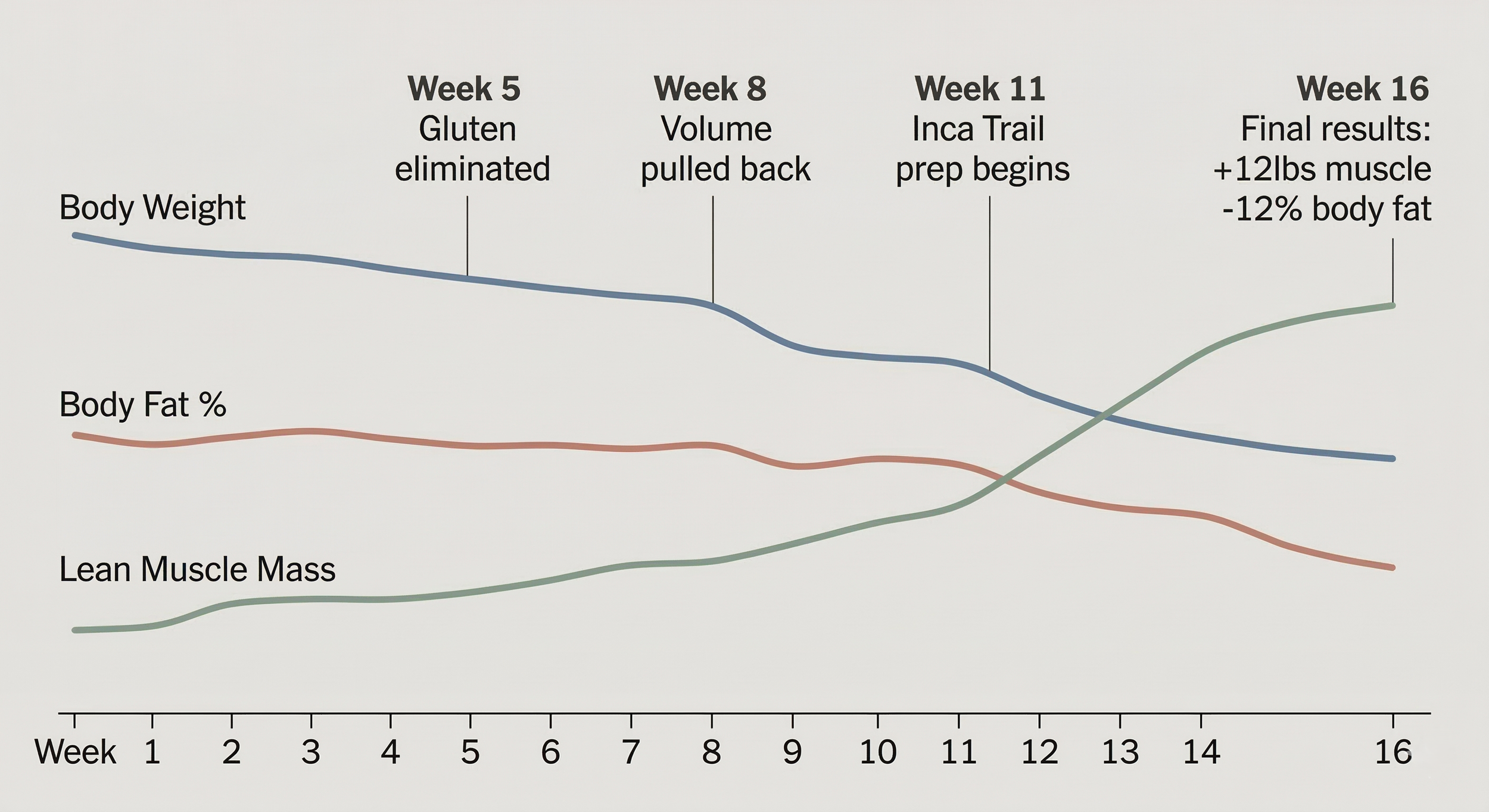
Andrews’ Results
Gained 12 pounds of lean muscle
Lost 12% body fat
Fitting into clothes he hadn't worn in 20 years again
And here's what Andrew said mattered most: he completed the Inca Trail in Peru at 56. Before the program, he knew he couldn't do it; his body wasn’t ready, and he would have gotten hurt trying. After 16 weeks, he crushed it. No injuries, no joint pain. Just a 56-year-old man hiking at altitude with the strength, conditioning, and durability to handle everything the trail threw at him.
Andrew wasn't lacking effort. He never was. He needed a program that matched his physiology at 56, addressed the gut inflammation that was blocking everything, built his aerobic base before touching intensity, and filled the nutrient gaps his diet was leaving. That's what changed. The work ethic was always there.
What Andrew Said
"Wow, where to start. What a life-changing process for me. I stalled and plateaued for years at the gym, intermittently connecting with trainers with little or no results. I worked hard too. However, the results I've seen with Coach Simon @ Dynamis Strength are amazing. I recently finished the Inca Trail in Peru at 56 years old, and I know for a fact that the pre-Dynamis Strength me wouldn't have been able to and most likely I would have injured myself. But my plan with Coach Simon not only focuses on strength, but also emphasizes flexibility and cardiovascular endurance. This includes a really flexible eating plan, focusing on macronutrients, and individualized supplements based on your goals. I'm fitting in clothes I haven't been able to wear for 20 years. If you want to feel healthier, fitter, stronger and more flexible, then I highly recommend you work with Coach Simon & Dynamis Strength."
What This Means if You're Stuck
If you're over 40, stuck despite putting in consistent work, and starting to wonder if your body is just done, it's not. But more effort applied to the wrong approach won't fix it.
You need to address the systems underneath: gut inflammation, recovery capacity, the nutrient gaps your diet is leaving, training volume that matches your age, and cardiovascular base before you touch high intensity. Andrew did this entirely remotely. No in-person sessions. Just a program that matched where his body actually was, consistent execution, and adjustments based on real data.
The work ethic was never the problem. It rarely is. The approach was.
ANSWERED.
About the Author